Taurine
Taurine is one of the best amino acids to help improve muscle soreness because it helps to push glutamate conversion ...


Taurine is one of the best amino acids to help improve muscle soreness because it helps to push glutamate conversion ...
Not all fats are created equal. Put simply, there are good fats and bad fats: the so called unsaturated and ...
Whey protein has been used in one form or another for at least 300 years, yet it has taken until ...
In what situations should I take carbs pre-workout? There is no situation where you NEED pre-workout carbs, but there are ...
By Roland Pankewich Read Part 1 HERE Read Part 2 HERE So far we have outlined some basic principles that ...

Is it true that resistance training stunts growth in adolescents? And can lifting really reverse the ageing process in older ...
By Roland Pankewich
If you have read the first installment (Read Part 1 Here) you were introduced to the idea that fat loss is a catabolic process which must be contextually supported if your goal is to lower your body fat percentage. We also mentioned that the mitochondria in our cells are the only cellular structures that are able to actually turn stored fat into energy the body utilizes as ATP. In this second part of the series we will focus on the “mechanics” side of metabolism and explore in detail just how the body can take fatty acids and turn them into energy.
To set the tone we must introduce the two different metabolic states in which we can make energy so we can better understand how the body uses fuel for a given activity.
This makes the model of having a robust aerobic metabolism that can efficiently burn fat a very important factor when it comes to fat loss. Given what most people know about training, there is likely a strong understanding of which energy system predominates specific exercise. We will examine the influence specific exercise has on fat loss later in the series after we go through some semi-painful biochemistry first.
Hang in here everyone, this part isn’t glamourous, but it is necessary to truly understand fat loss and energy metabolism. I promise I will make it as fundamental as possible.
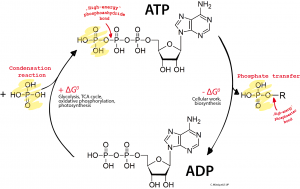 When it comes to calories, in some regards the body doesn’t care what it uses as it can make ATP from all calories containing substrates (protein, carb, fat). It simply converts these calories into intermediary compounds that it can transfer into the kreb’s cycle and ultimately produce these two electron donating compounds known as: NADH & FADH2. These electron donors enter the mitochondria and create a scenario where ATP is formed and distributed among the various structures in the cell in order for the cell to complete various tasks.
This is the end result of burning ALL macronutrients aerobically, and even though I said the body doesn’t technically care which nutrients it burns, there are some peripheral advantages of focusing on fat as a primary fuel source. The human body is in a constantly flux when it comes to energy status, when we eat we are flush with energy and when we don’t we can rely upon our energy stores to supply the body with fuel. This is one of the key variables we need to manage when it comes facilitating fat loss as fat can only be burned when certain endocrine and metabolic signals are stimulated.
Let’s round out this second installment with tracing the pathway of how the body physically burns the stored fat. Fat is stored in specialized fat cells called adipocytes which are just storage vessels around the body. This is where the flux happens because they either are storing or releasing based upon the internal environment. In a situation where the body needs more energy, the following process happens:
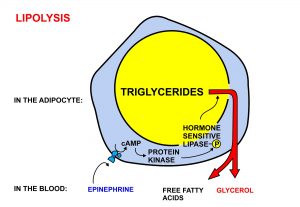
A far more practical way of looking at this is when energy demands are high and the body must turn to fat for fuel the following steps happen:
Although this is a simplified version of the process which is both painful and intimidating to look at, the fundamental takeaway is that our body has a very unique and elegant process where it can regulate energy homeostasis with stored fat being utilized for energy. This is likely why the human body has gotten so adept at storing and burning fat, when food wasn’t available, we needed a way to survive without constant carbohydrate consumption. Fat is both more energy dense at 9cal/gram and fat stores even on a lean person can be upwards of 50,000 calories whereas the maximal amount of carbohydrate that is stored in the body is likely between 400-700grams depending on the person and the amount of muscle they have .
Now that we are getting much deeper into the biochemistry and we have a base understanding of the steps in the metabolic process, next time we will examine the key variables that induce lipolysis (fat loss) from an endocrine perspective and the necessary actions to ensure optimal mitochondrial function.