• All
  • Back / Lats
  • Biceps
  • Chest
  • Coaches Corner
  • Delts
  • Exercise Execution
  • Hormones & Physiology
  • Legs
  • Nutrition
  • Premium Articles
  • Supplements
  • Training
  • Triceps
muscle fiber anatomy

Myofibrillar vs. Sarcoplasmic Hypertrophy: Two Ways to Grow

We've all seen the Bruce Lee-types, the small men with profound strength, and the contrary, muscle men that are all ...

Read More

Occlusion Training: Lift Light to Mass Up

In matters physiological, the process of occlusion has largely negative connotations. Occlusion, meaning to shut off or obstruct, of a ...

Read More

What Is The Fastest Way to Lose 10lbs of Fat?

The first thing to discuss here is what it really is to lose 10lbs of pure fat. Most people lose ...

Read More

Testosterone: Understanding the Mechanisms Behind the “Alpha” Hormone

Everybody's familiar with testosterone, the grand daddy hormone most synonymous with both muscle and manhood. Today we provide a comprehensive ...

Read More

The Biology of Fat Loss Mechanics – Part 1

By Roland Pankewich Fat loss is the ever-elusive conquest of anyone and everyone who is into health and fitness. Observationally ...

Read More

MI40 Strength: Intro to Coach Adam, & Boss of Bosses Meet – Part 1

MI40 Strength Coach Adam Miller coming at you with an intro into the world of powerlifting... and how you can ...

Read More
  See More

Ab Leg Raises


General guidelines for all ab targeting leg raise movements
(unless specifically stated otherwise)

  • before beginning the concentric portion, exhale all air from the lungs / diaphragm and suck in the stomach (bring ribs to the rib cage), remove any arch in the back, then contract the abs and begin the concentric
  • maintain constant tension on the abs throughout; aim to maximally lengthen and fully shorten the abdominal wall (keep in mind that the function of the abs is to flex and extend the spine so pay attention to what’s happening at the spine); the moment the abdominal wall relaxes, begin again with the concentric portion of the movement.
  • ideally, perform with relatively straight legs, with just a very slight and consistent bend in the knees
  • roll hips / whole pelvic girdle up at the top (unless directed otherwise)
  • maintain constant movement (no rest at the bottom)
  • pay extra attention to staying under control; no swing on the way, plus don’t allow the body to just ‘fall’ through the negative
  • to de-activate assistance from the quads and hip flexors, aim to activate the hams and / or glutes whenever possible.
  •  
    * if you want to work the obliques in addition to the lower abs, simply add a twist at the top of the movement.


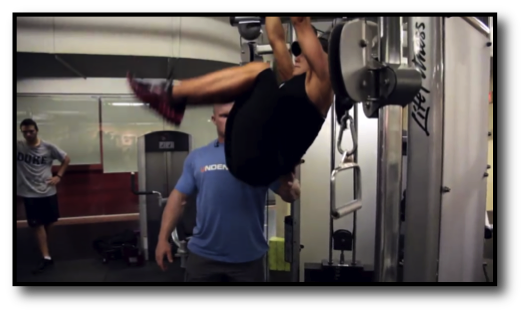
Hanging Leg / Knee raises (emphasizes lower abs)

Leg Raises (at the top of the movement)
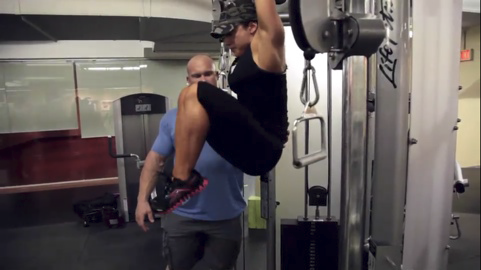
Knee Raises (at the top of the movement)
    Exercise Specific:

  • hang directly from a bar with hands shoulder-width apart, or instead use a ‘Roman Chair’ apparatus.
  • For the Knee-Raise Variation: bend at the knees significantly and bring them straight up to the chest.


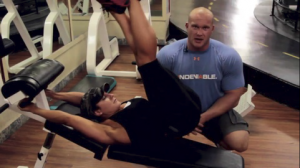
Lying Leg / Knee Raises (emphasizes lower abs)

Leg Raises: Can be performed on an decline bench as shown above if ability allows
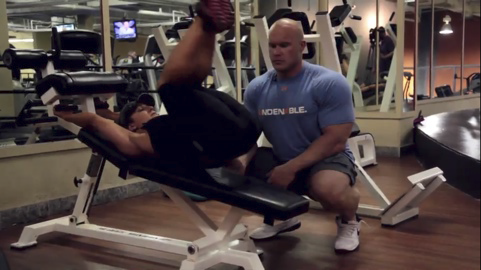
Knee Raises: Depicted at the top of the movement
    Exercise Specific:

  • can be done on the ground, or, if more advanced, on an ab bench with a slight decline; if done on a decline, come down only until the abdominal wall relaxes (likely around 45º)
  • come up as high as possible depending on any potential lower back issues you may have; if your lower back is an issue, perhaps restrict the range somewhat turning this more into a slight pelvic roll.
  • For the Knee-Raise Variation: bend at the knees significantly and bring them straight up to the chest
  • Variation using Stability Ball:
       > feet wide
       > hands at sides
       > grab ball with heels and roll the hips back as much as possible.


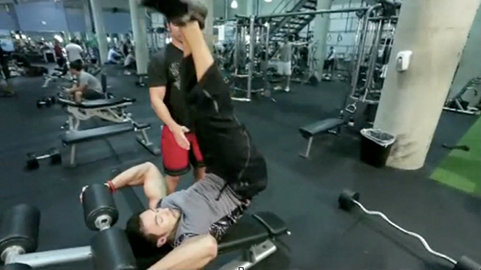
Pelvic Roll – toes to sky (emphasizes lower abs)

As depicted, can be performed on a decline bench if ability allows
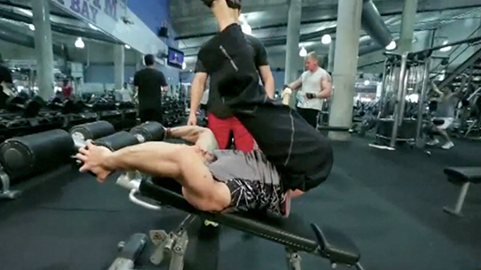
    Exercise Specific:

  • position legs at 90º straight up with knees locked (aim to keep them perfectly vertical throughout, don’t allow them to come backwards at all)
  • execute by rolling the pelvis straight up and down (aim feet to the ceiling on the ascent).


‘Reverse’ Leg Raises – focus on top half (emphasizes lower abs)

Bottom position. Can be performed on a decline bench as depicted if ability allows

    Exercise Specific:

  • roll pelvis back / up as high as possible (this is the start / end point)
  • from here, maintaining straight legs, bring them back as close as possible to the head
  • the movement is basically pulsing the legs back and forth within this short range (keeping the abs in a particularly shortened position).